
A Refining Fire
What my Shoulder Injury Taught me about Sin and Sanctification

In what would become his last Cross Country meet, Chris ran with determination. He truly desired to make his coach proud and run his best time. As most Cross Country races happen out of spectators’ sight, my husband and I had to hurry to each viewing point, so we could catch a glimpse of him and cheer him on before he vanished into another stretch of downhill field or wood.
At the last place we could see him before the finish, we noticed a concerning grimace of pain as he passed. “Are you ok?” I called out futilely. And we rushed to wait for him at the finish line. As he came around the bend, we could see something was definitely wrong, but he pushed through and crossed, finally collapsing and rolling onto his back. “Good job, Chris, but you gotta keep moving. Ain’t good to just stop,” his coach told him, reaching out a hand to help him up. When he shook his head instead and said “I can’t,” real worry set in.
An x-ray later revealed fractures in both of his shins. My boy had been running on broken legs.
I never knew anyone with that kind of pain tolerance, but then I remembered my own experience with pain. Maybe he got it from me.
Two and a half years ago, when I could only turn my head to the right about 10 degrees and lifting my arm any higher than shoulder height brought searing pain and tears, I finally conceded to see the chiropractor both my mom and sister were begging me to see.
I have had pain in my trapezius muscles (both, but particularly my right) since my young teacher days. The school where I taught did not have enough classrooms for all their teachers, so a handful of us were itinerant, traveling from room to room throughout the day. Teaching three different literature classes meant having three different anthologies plus any accompanying papers, tests, plans, and miscellaneous teaching paraphernalia. Instead of using a cart, like I saw a few of the older (and wiser) teachers using, I opted for a bag, which I always carried on my right shoulder. As a new teacher, I was still learning a lot about how to manage all the materials I used and needed; so the fear of finding myself without something led me to just carry everything with me all day. Unbeknownst to me at the time, my heavy bag damaged some neck and back muscles and my active lifestyle contributed to further damage.
Despite the pain, (which I merely chalked up to stress tension), I continued to exercise. At times, the pain would restrict movement, but most times I could “muscle through it.” Until eventually, I couldn’t. I tried heat, ibuprofen (only when absolutely necessary), hot baths, and massage, but relief was only short lived.
I finally found a massage therapist whose hands had enough endurance and strength to make a dent in my rock hard trap muscles. He told me I had myofascial trigger points all through my neck and shoulders—dense knots formed within the muscle fibers which create a sustained contraction.
Money and time ran thin, and I had to stop going. Fast forward a decade, and the pain had become debilitating. Enter the chiropractor and his miracle machine, the Piezowave.
Here’s a brief description of Piezowave Therapy from Body Pro Chiropractic and Sports Medicine:
Piezowave, also known as shockwave therapy, is a myofascial acoustic compression technique invented by Richard Wolf, who developed a special device that uses precisely targeted sound waves to stimulate the musculoskeletal system underneath your skin. This Piezowave device sends thousands of sound wave pulses into a precisely targeted tissue or muscle, and works in tandem, resulting in stimulation that provides pain relief and leads to improved circulation in the targeted area triggering your body’s own natural healing processes.
For maximum benefit, the sound waves are accurately adjusted for both depth and intensity and can help to heal tissues that lie too deep for conventional physical manipulation.1
My chiropractor explained that the “piezoelectric pressure pulses” break down scar tissue, enhance blood flow, and stimulate new stem cells which all aids in healing and repairing damaged tissues. He was actually startled by my lack of mobility and couldn’t wait to get started.
It hurt. A lot.
It’s difficult to describe exactly how it felt, but “lightning” comes to mind.
For Better or Worse?
His immediate prescription was to see him three times a week for a minimum of six weeks. The fun part is his office was an hour away from where I lived, but I was in so much pain, I didn’t care.
After seeing him regularly, a strange thing happened.
I began to feel worse.
I began to hurt in areas of my right upper arm and back that didn’t hurt before. I couldn’t sleep. Getting comfortable was impossible. And my husband began getting very concerned and upset. I asked my doctor why I was hurting more, was that normal?
He explained that the damage to my muscles was more extensive and deeper than he initially thought. I had a lot of scar tissue, and it had grown and spread and had actually wrapped around nerves strangling them to death… like literally to death… the scar tissue had cut off blood and some of my nerves deep inside had died. The truth is, with my continued activity (like strength training), I was inflicting more damage on myself and wasn’t even aware of it.
The piezowave therapy was working to repair those dead nerves and as they healed, they could communicate again. Their mode of communication is sending pain signals to my brain that the muscle they live in is damaged and hurting. When I began to really feel the pain, I stopped the strength training for a time.
Six weeks turned into a year, and if our youngest child hadn’t started having real problems with school which required me being closer to home every day, I’d still be going. The pain is manageable once again, but it’s still there. There is more healing to be done.
A Metaphor for Life
I love a good metaphor, and I couldn’t help but think of how this relates to sin.
Like the scar tissue in my muscles, sin also strangles the life out of us. We become insensitive to pain points. We lose communication with God. We continue to inflict more damage on ourselves.
In one of my favorite books in the Bible, Romans, Paul thoroughly describes the war between good and evil, not only seen in the world, but also within the Christian. He explains that even those who never formally received the Law of God, (the Gentiles), “show that the requirements of the law are written on their hearts, [and] their consciences bear witness [to it].” (Romans 2:15)
The Gift of Conscience
“The conscience is defined as that part of the human psyche that induces mental anguish and feelings of guilt when we violate it and feelings of pleasure and well-being when our actions, thoughts and words are in conformity to our value systems.
The Greek word translated “conscience” in all New Testament references is suneidēsis, meaning “moral awareness” or “moral consciousness.” The conscience reacts when one’s actions, thoughts, and words conform to, or are contrary to, a standard of right and wrong.” (from GotQuestions.org)
The conscience is a God given gift that enables us to evaluate ourselves according to the standard of God’s perfect law. In this way, the conscience will accuse or defend the individual. Guilty feelings are meant to drive us to confession and repentance. In Psalm 38, David painfully describes how the overwhelming guilt of his sin is felt in his physical body:
“My bones have no soundness because of my sin. My guilt has overwhelmed me like a burden too heavy to bear. My wounds fester and are loathsome because of my sinful folly…My back is filled with searing pain; there is no health in my body. I am feeble and utterly crushed; I groan in anguish of heart.” (vv. 3-5, 7-8)
Unfortunately, however, repeatedly ignoring the promptings of our conscience can lead to its hardening, or calcification. Paul writes of false teachers who are no longer sensitive to the conviction of conscience and says they are “hypocritical liars, whose consciences have been seared as with a hot iron.” (1 Timothy 4:2)
And in his letter to Titus, Paul speaks of “rebellious people, mere talkers and deceivers” who would lead believers astray as “both their minds and consciences are corrupted. They claim to know God, but by their actions they deny Him.” (see Titus 1:10-16)
Pursuit of Holiness
As well as seeing how scar tissue relates to sin and a seared conscience, I also couldn’t help but reflect on the healing process as well. It is gradual, slow, and sometimes, at first, makes you feel worse.
As it is in our journey of sanctification.
The closer we get to God, the more we understand His holiness; the clearer we then see ourselves and our unholiness. When our pain receptors are healed by the grace of God, we see (and feel) more clearly the blackness of our hearts and the coals we’ve heaped on our heads.
Isaiah speaks for us all when, after seeing a vision of the Lord, he cried out, “It’s all over! Woe to me! I am doomed! For I am a sinful man. I have filthy lips, and I live among a people with filthy lips. Yet my eyes have seen the King, the Lord Almighty!” (Isaiah 6:5)
In contrast, when habitual sin has rendered our consciences insensitive to the convictions of sin, we won’t feel the pain of guilt. We don’t sense the need to repent. We are in danger of becoming who Paul described as those whose “thinking became futile and [whose] foolish hearts were darkened.” (See Romans 1)
The Refiners Fire
As with my injury, I tried for many years and in many ways to alleviate the pain at the surface. Essentially, I was masking the problem, when what I needed to do was get to the root of it.
After Isaiah exclaimed his doom upon seeing the holiness of God, “One of the seraphs flew to him with a live coal in his hand, which he had taken with tongs from the altar. With it he touched [Isaiah’s] mouth and said, “See, this has touched your lips; your guilt is taken away and your sin atoned for.” (Isaiah 6:6-7)
How do we maintain sensitivity to sin and closeness to God?
By submitting to the refining fire of the Lord. Unlike the branding iron that sears and renders insensitive, the Lord’s refining fire cleanses and purifies. “He will sit as a refiner and purifier of silver; he will purify [us] and refine [us] like gold and silver.” (Malachi 3:2-3)
As gold and silver melt in the heat of a furnace, impurities float to the surface (called “dross”) and are carefully skimmed off. The resulting cooled and solidified metals are a more pure form. Through Isaiah, God told Israel that He “will thoroughly purge away [their] dross and remove all [their] impurities.” (Isaiah 1:25)
He can do this through the “furnace of affliction”2—trials and tribulations—that Peter tells us “have come so that [our] faith—of greater worth than gold, which perishes even though refined by fire—may be proved genuine.” (1 Peter 1:7)
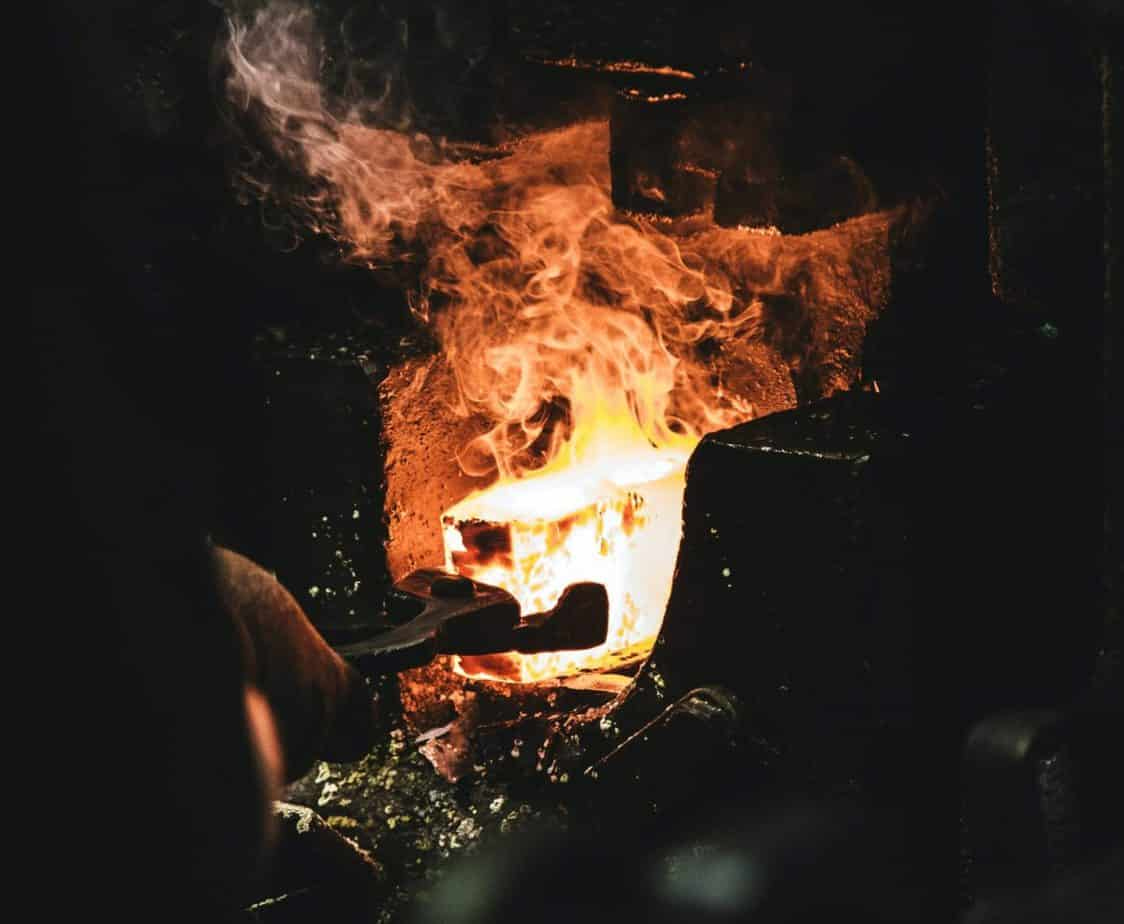
As the Lord refines us through sanctification, the impurities of sin will be raised from darkness, the scars of sin will be burned away, and our hearts healed. Our faith will be stronger and more valuable than gold. Our connection with our Head, attuned to His leading. We need never fear the Lord’s refining fire; it is for our good, and for His glory. As He promises us in Isaiah 43:
“Fear not, for I have redeemed you; I have summoned you by name; you are mine.
When you pass through the waters, I will be with you;
and when you pass through the rivers, they will not sweep over you.
When you walk through the fire, you will not be burned;
the flames will not set you ablaze.
For I am the Lord, your God, the Holy One of Israel, your Savior.”
(vv 1-3)
See Isaiah 48:10
This is excellent, Vanessa. I like how you wove in so many references from the old and new Testaments, especially the Psalm at the end, which is so poetic.
But I have to ask, how is your physical condition today?
I really appreciate how grounded in scripture and rock-solid doctrine your posts always are.