
Covered by God
Thoughts on God's Covering, Protection, and Love

In the 2017 Christmas folder on our computer, one would find videos and photos of two little brothers—the older, seven, and the younger, four—making gingerbread cookies in their birthday suits. Yep. Both of them—naked as the day they were born and not a shred of shame for who saw them that way.
In one of the videos, you can see me shaking my head in resignation but continuing to roll out the dough and cut out the little gingerbread men—who were also naked now that I think about it.
The boys thought it hilarious at the time—embarrassing Mommy with their gleeful liberation. Our four-year-old spent about 80% of his time that way, and so, both boys thought it perfectly natural to make Christmas cookies that way too.
I’m not altogether sure when it happened, but one day my middle child no longer thought it amusing to run around the house naked. Rather all of a sudden, it seemed, he began changing his clothes inside the closet and locking the bathroom door when he needed to use it. Hiding his nakedness was now the perfectly natural thing to do. And what is most interesting about this is that neither I nor his father taught him to do this. We never said “Son, you’re so many years old now. It’s time you stop streaking through the house.” We just let it happen naturally, and as if right on cue, it did.
Of Covering
I’ve been thinking a lot about covering lately. The ways we try to cover ourselves; and the better way God covers us.
I’ve been thinking about how cyclical things tend to be—in Biblical history, in my own history.
And I’ve been thinking about how utterly amazing God’s Word is. The stories. The details. The foreshadowing. And how easily I miss things in those stories, details, and foreshadowing until someone more learned or studied than I point them out to me and I say “Wow! It was right there all the time. And I missed it!”
Like my boys, there was a time when our first parents felt no shame in their nakedness. (“And the man and his wife were both naked and were not ashamed.” Genesis 2:25—the final verse of chapter two before the fall)
But sin revealed a conscious awareness of their unclothed state. And they attempted to cover their shame with leaves. (“…she took of its fruit and ate, and she also gave some to her husband who was with her, and he ate. Then the eyes of both were opened, and they knew they were naked. And they sewed fig leaves together and made themselves loincloths.” Genesis 3:6b-7)

I’ve been considering this. One of the first consequences of their sin was shame for their nakedness. And their instinct was to immediately cover it. Genesis 2:25 implies they knew they were naked, but in contrast to Genesis 3:7, they had felt no shameful awareness about it.
They sewed fig leaves together and hid their most private parts—the parts created by God to proliferate life. Which reminds me of the barren fig tree in Matthew. (“In the morning, as He was returning to the city, He became hungry. And seeing a fig tree by the wayside, He went to it and found nothing on it but only leaves. And He said to it, “May no fruit ever come from you again!” And the fig tree withered at once.” Matthew 21:18-19) Like the fig tree, Israel was also barren (spiritually) but had attempted to cover its barrenness with “leaves” of religiosity. Though it may have appeared promising, it produced nothing life giving—like “clouds blowing over the land without giving any rain. They are like trees in autumn that are doubly dead, for they bear no fruit and have been pulled up by the roots” (Jude 1:12 NLT)
But leaves don’t last. I’m sure children’s storybook illustrations influenced my thinking, but I’ve always imagined Adam and Eve covered by perpetually green leaves. That would not be accurate, however, because eventually, deprived of their source of life, the leaves would begin to yellow, turn brown, and finally crumble into dust. The pair would need to make covering for guilt and shame—again and again.
In His mercy and compassion, the Lord provided acceptable covering for them. (“And the Lord God made for Adam and for his wife garments of skins and clothed them.” Genesis 3:21) I’ve often wondered what innocent animal died to cover their guilt.1 Were they clothed in the clean, white wool of the lamb? The Bible doesn’t say. We are told though that their son, Abel, was “a keeper of sheep” and had brought “an offering [to the Lord]—fat portions from some of the firstborn of his flock” and the Lord “looked with favor on Abel and his offering.” (Genesis 4:4 NIV)
We cannot miss the way this scene points ahead to the spotless Lamb of God who “takes away the sin of the world” —our Lord Jesus Christ.
Our vain attempts to cover our own unrighteousness with good deeds, traditions, and forms of religion are but filthy rags before the Lord.2 The only permanent and perfect garment must be provided by God. We must be clothed in His righteousness. (“I counsel you to buy from Me gold refined by fire, so that you may be rich, and white garments so that you may clothe yourself and the shame of your nakedness may not be seen, and salve to anoint your eyes, so that you may see.” Revelation 3:18)

Of Protection
Did you know that the Hebrew word “tevah,” which literally means “box,” is only seen in two places in the Old Testament? I only just learned this recently after listening to a sermon by Dr. Voddie Baucham on Genesis 6.3
In Genesis 6:14 we read, “Make yourself an ark (tevah) of cypress wood. Make rooms in the ark, and cover it inside and out with pitch.”
The second time the word “tevah” is seen is in Exodus 2:3 to describe the container baby Moses was placed in for protection. “When she could hide him no longer, she took for him a basket (tevah) made of bulrushes and daubed it with bitumen and pitch.” Whether translated “basket” (as in the ESV and NIV) or “ark” (as in the NKJV and ASV), the original Hebrew reads “tevah.”
Don’t miss the wonderful plan of redemption our Lord unfolds from one story to the next! In Noah’s day, the wickedness that covered the earth was overwhelming. (The Lord saw that the wickedness of man was great in the earth, and that every intention of the thoughts of his heart was only evil continually. Genesis 6:5) The Lord “regretted that He had made man” and it “grieved Him to His heart.” He said, “I will blot out man whom I have created.” But through the supernatural intervention of God, one man “found favor in the eyes of the Lord.” Noah was a “righteous man, blameless in his generation” and “walked with God.” (Genesis 6:6-9) Was he sinless? No. But he walked faithfully with God by way of His mercy and grace.
Under the protection of God’s mercy and in the ark of provision, Noah and his family were delivered from the flood of God’s judgment, wrath, and death.
And we see elements of this story retold through the preservation of Moses’ life, who also survived drowning under the protective hand of God and His ark of provision.
“Then Pharaoh commanded all his people, “Every son that is born to the Hebrews you shall cast into the Nile…”
“The woman conceived and bore a son, and when she saw that he was a fine child, she hid him three months. When she could hide him no longer, she took for him a basket made of bulrushes and daubed it with bitumen and pitch. She put the child in it and placed it among the reeds by the river bank.
[The daughter of Pharoah] saw the basket among the reeds…and she took it… She saw the child, and behold, the baby was crying. She took pity on him and said, “This is one of the Hebrews’ children.” Exodus 1:22, 2:2-3, 5-6
In both accounts we see God choose two men and like “brands plucked from the fire,”4 He mercifully covers and protects them from judgment, wrath, and death, and uses them as instruments of His redemption—pointing to a Greater and Final Redeemer.
Of Promises
Scripture describes yet another ark created to cover and make provision. In Exodus 25, the Lord instructs Moses to make the Ark of the Covenant which will be the most holy object in the tabernacle.
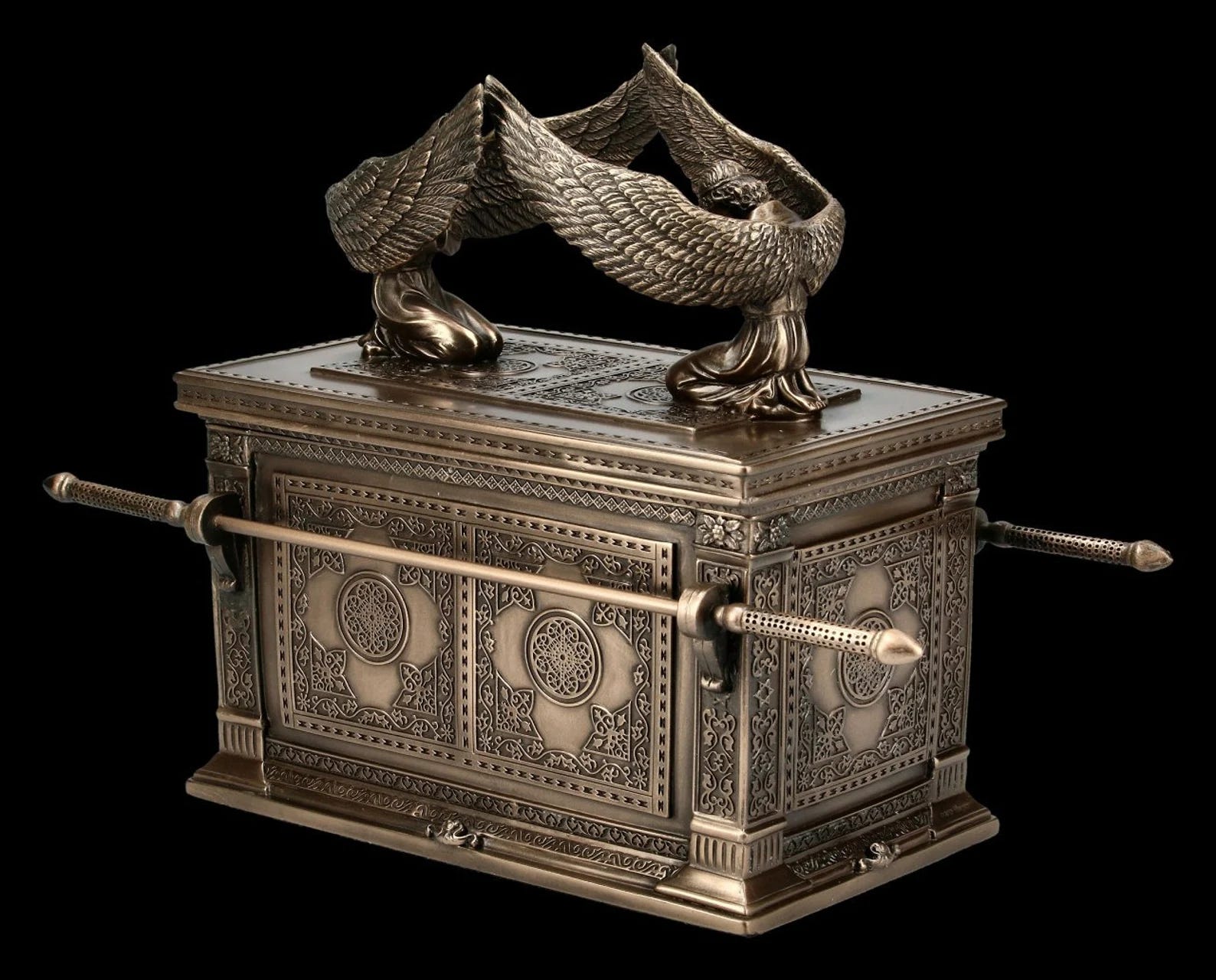
The Ark of the Covenant would contain the terms of God’s covenant (written on the stone tablets given to Moses on Mt. Sinai—the Law), a gold pot of manna (a symbol of God’s provision in the desert: the bread of heaven), and the budding staff of Aaron (which represented God’s authority to appoint leaders and mediators; and also demonstrated God’s ability to bring life from death)5
To cover the ark, Moses was to also make “a mercy seat of pure gold.”
“You shall make a mercy seat of pure gold… And you shall make two cherubim of gold…Make one cherub on the one end, and one cherub on the other end…The cherubim shall spread out their wings above, overshadowing the mercy seat with their wings, their faces one to another…[looking at the mercy seat]…And you shall put the mercy seat on the top of the ark, and in the ark you shall put the testimony that I shall give you. There I will meet with you, and from above the mercy seat, from between the two cherubim…I will speak with you…” (Exodus 25:17-22)
Once a year, on the Day of Atonement, the high priest would go behind the curtain into the Holy of Holies and make atonement for himself and the people of Israel by sprinkling the blood of the sacrifice onto the mercy seat.6
Seventeen years ago, I was studying the Gospel of John, and it was then that the reason for Christ’s death became crystal clear. And though I had called myself a Christian all my life, it was then that I uttered the words, “It’s all true.”
“But Mary stood weeping outside the tomb, and as she wept she stooped to look into the tomb. And she saw two angels in white, sitting where the body of Jesus had lain, one at the head and one at the feet.” (John 20:11-12)
The Mercy Seat.
“There I will meet with you.”
Jesus.
Where God’s justice and mercy meet.
“It is finished.”
Paid in full.
Covered by God
I see You—
through whom and by whom and for whom all was made—
and I want to hide my eyes.
The artist captured the agony; the cloth covers the shame.
But I look. Leaving my eyes uncovered
in order that my heart may see
and feel
what pain, what love
on the cross.
Stripped of Your covering
You wear the filthy rags of
my disgrace. my shame. my guilt.
Refusing the galled wine
You drink—instead—every drop
of the Cup
Your body—torn in death,
tears the curtain
that separated me from God
inviting me into Your holy place.
You gather me in
to Your ark.
Called
Sealed
Protected
Delivering me
through the whelming flood
Clothing me
in Your garments
of love.
“I delight greatly in the Lord; my soul rejoices in my God.
For he has clothed me with garments of salvation
and arrayed me in a robe of his righteousness,
as a bridegroom adorns his head like a priest,
and as a bride adorns herself with her jewels.”
Isaiah 61:10
“For the life of a creature is in the blood, and I have given it to you to make atonement for yourselves on the altar; it is the blood that makes atonement for one’s life” (Leviticus 17:11). The author of Hebrews further explains, “Without the shedding of blood there is no forgiveness” (Hebrews 9:22).
“All of us have become like one who is unclean,
and all our righteous acts are like filthy rags;
we all shrivel up like a leaf,
and like the wind our sins sweep us away.” Isaiah 64:6
See Zechariah 3 for an amazing illustration of how we are saved by God’s mercy and grace and how Christ’s righteousness is imputed to us.
The story of Aaron’s budding rod is rich with meaning! Read here for further details and explanation.
Hebrews 9:4 lists the contents of the Ark of the Covenant.
Read Leviticus 16 for God’s complete instruction regarding the Day of Atonement.
I especially loved the poem and your revelation about the mercy seat! Wow!
Was looking forward to your post today. I was not disappointed! You are a master story weaver!