
Help Me Let Go
How A Heart Content in the Lord Can Better Embrace Seasons of Change

I thought things were fine.
But they weren’t.
At his final lesson of the year, his piano teacher helped him create an ending to his recital piece. The piece which had taken more than a year to learn. The piece which was several years more advanced than he was.
I knew he felt disappointed that time had run out to master the final page and he would therefore perform only the first four. I knew he felt like he had let people down, mostly himself. I also knew to just keep quiet about it on the way home.
My natural tendency is to find the ‘silver lining’ in situations. I enjoy encouraging people. But my mother’s instinct told me it wouldn’t help this time.
I thought things were fine, but a few minutes after coming inside, I heard crying.
I waited. It wasn’t crying; it was sobbing.
I bolted upstairs and opened his door, rushing to him. “Honey, are you all right?”
“I need a minute,” he cried, overwhelmed. And then I noticed the phone in his hand and heard his girlfriend’s voice, “Just breathe. Nice and slow. In…two, three, four. Hold. Out…two, three, four. Hold.”
I nodded to him and backed out of the room. I stood a few minutes in the hallway listening as this sweet girl led my boy in the same breathing exercises I used to teach him. And it dawned on me that time is advancing more quickly than I even imagined it was.
Helpless to slow things down, time slips through our fingers like grains of sand.
I was sitting with my youngest just a month ago while he told me stories and as I looked at his young, sweet face and listened, I saw a maturity that was not there a minute before. It lasted only a brief moment, but long enough to leave an impression on my heart. My baby is growing up.
Later, I wrote a prayer to God about it—
I want to remember this memory.
O Lord, would you knit it into my mind?
I want to recall how he talks to me—
his laughter, his stories—I’ll never find
another time like right now when I’m what
he seeks for cuddles and tickles and love.
Oh, how my heart aches and bleeds like it’s cut
when I think how soon he’ll be dreaming of
life beyond these four walls—a thing I dread.
Though now he wants kisses and tucked in bed.
When I think about the early years with my babies, I pull those precious ‘firsts’ and ‘lasts’ from the recesses of memory and savor each tender moment a while. Their first smile, first wobbly steps, first words. The bittersweet last time I nursed each one. Life seems to be one long series of beginnings and endings, doesn’t it?
Knitting each one together in my womb, the Lord decided the color of their eyes, the curl and texture of their hair, how tall each would be. He planned and crafted each day they would live on earth including joys and sorrows. And wonder of wonders, He chose me to be their mother. To nurture and guide. To teach and correct.
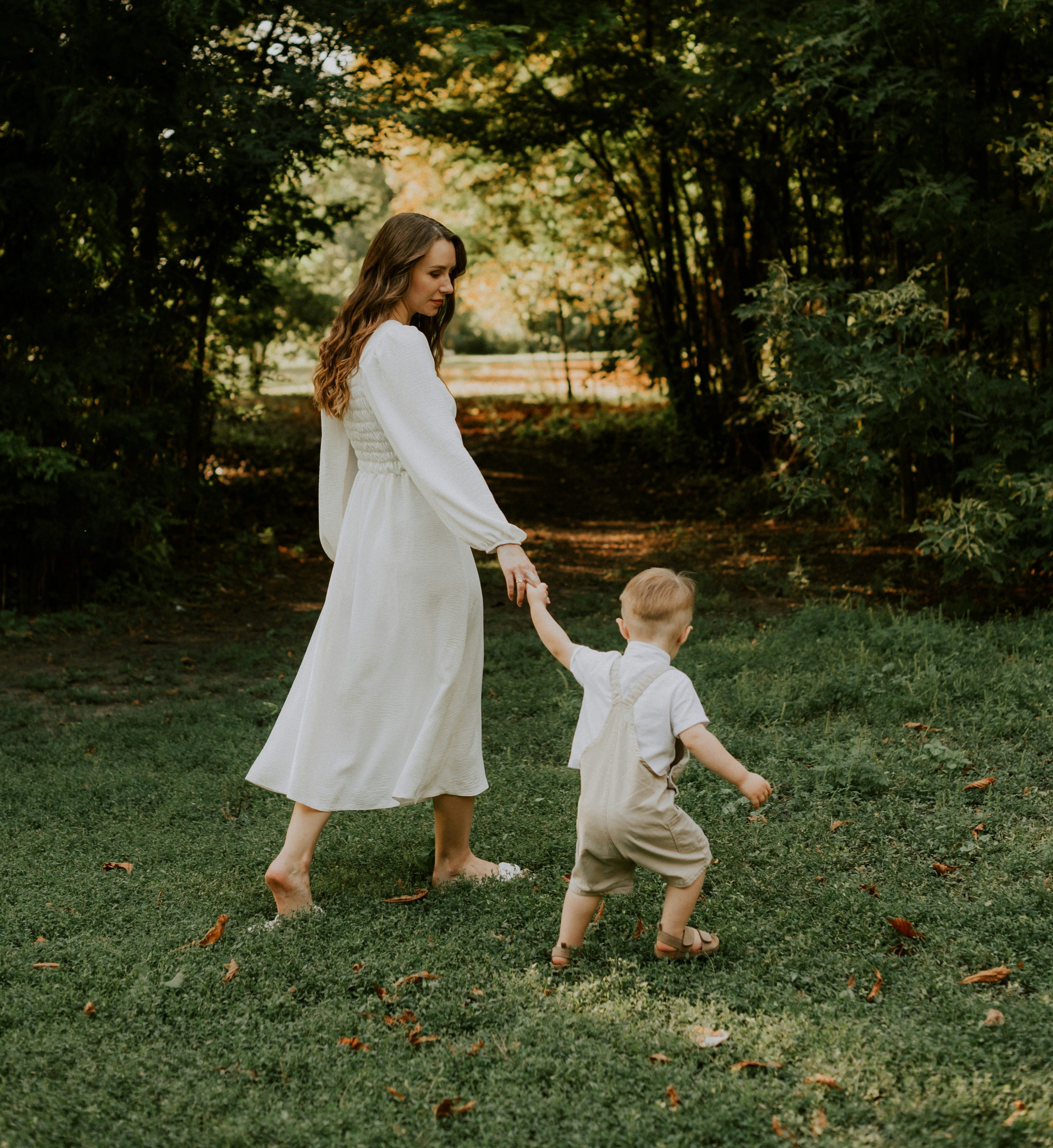
To walk this road of childhood together, hand in hand, all the while preparing each to live his life without me.
While reading Psalm 139, I began to work out the idea of being ‘knit together.’ What a wonderful choice of words. While I never learned to knit, my grandmother did teach me to crochet, and I think the process is similar enough to appreciate the metaphor.
To create an afghan, for example, the crocheter first chooses a pattern, yarn, and hook. Will there be stripes or squares? Perhaps some tassel embellishments? Will there be multiple shades or a single hue? Will the work reveal simple lines or an intricate motif? Will the blanket be fine and delicate or strong and durable?
With a completed picture in mind, the crafter begins, taking care to create the right number of stitches in each row, skipping when necessary, making double and triple knots where required, and finishing edges by neatly weaving in ends.
The Master Weaver fashioned each of us this way using careful precision, thoughtful planning, and divine artistry. This does not describe the casual work of some cosmic accident, but rather an intimate, personal, even tender work of craftsmanship by an intentional Creator.
At times, I am caught off guard by time’s passage and guilt and regret plague me. My mind begins a looping critique of all my missteps and failures and, quite honestly, my natural inclination is to grab hold of that which I fear losing all the tighter. ‘If I could only have more time, I could fix everything!’ my thoughts scream as if God listed ‘a perfect life’ on my To Do list.
“Help me let go, Father.”
And not only of my maturing children, but of my agenda. My will. My hopes and dreams for what becomes of their lives.
Minimalist author and speaker, Joshua Fields Millburn, teaches his audience: ‘The best way to let go of something is to stop clinging to it.’
I sat alone in the car after school drop off the next morning (the morning after I realized my teen son was advancing toward independence at breakneck speed—well, that’s how it feels anyway) and after a good cry, I talked to God about why it feels so hard to let him go. ‘Am I clinging to my children, Lord?’
Am I clinging to time?
Am I clinging to control?
Am I clinging to pride?
Do I not trust You enough, Lord?
Do I still believe I’m what he most needs?
Do I want to be what he most needs?
I think about Hannah and how she must have delighted in Samuel. “When we can name our blessings Samuel, that is, “asked of God,” they will be as dear to us as her child was to Hannah,” writes Spurgeon.
Nursing him, teaching him, soaking in the wonder of him all the while preparing him (and herself) for the day she would walk him to Shiloh and say goodbye.
I don’t imagine for one moment that leaving the child for whom she fervently prayed was easy for Hannah. But she did not cling to him, instead, I picture her clinging to the Lord. The one true constant in her life.
Perhaps in quiet moments of preparation, she prayed “Help me let go,” like I did.
Do you remember how impassioned her pleas were for a child? Before Samuel came into her life, Hannah’s prayers at Shiloh were filled with “bitterness of soul” and much weeping. But after explaining her deep anguish and grief to Eli, the priest, Scripture tells us, “she went her way and ate something, and her face was no longer downcast.” (see 1 Sam 1:1-18)
What had changed?
Puritan preacher, Jonathan Edwards, explains how tenderly the Lord often reveals Himself to us while in prayer:
“He reveals Himself to us by special discoveries of His mercy and sufficiency. While we are praying, He gives us sweet views of His glorious grace and sovereignty. He enables us to rest in Him and leave our prayers with Him, submitting to His will, and trusting in His grace and faithfulness.
Hannah came and poured out her soul before God, and He quieted her mind, and took away her sadness. This seems to have been from refreshing discoveries which God made of Himself to her, to enable her quietly to submit to His will, and trust in His mercy.”1
The function of prayer is not to influence God, but to transform the heart of the one who prays. It’s a lifelong process, but what an immense blessing and grace of God it is to discover that He is so much more sufficient than the thing for which we pray. And it is in that sweet knowledge that Hannah goes home consoled and content.
El Roi, ‘the God who sees,’ sustained her through the trials of Peninah’s provocations and through the heartbreak of a closed womb, and He continued to sustain her as He led her by the hand to Shiloh in order to fulfill her vow. To let him go. God bestowed on her (as He does all His children) racham—the Hebrew word for ‘compassion.’
According to Strong’s Topical Lexicon, רַחַם (racham) “expresses a visceral, womb-like tenderness that moves one to merciful action. It is never a cold or abstract pity; the word pictures warm parental affection that both feels and does. While often rendered “mercy” or “compassion,” its imagery of the womb links it to life-giving protection and nurture.”
“He tends his flock like a shepherd:
He gathers the lambs in his arms
and carries them close to his heart;
he gently leads those that have young.”
—Isaiah 40:11
Racham.
Change is never easy, but it is through change we learn dependency on God’s sustaining grace and experience His unfailing love. We cannot know the full plans of God (for us or for our babies), but in humility and trust, we can cling to the truth that all He does for His children is done to further their transformation into Christlikeness and bring glory to His Name.
Hannah did not cling to her son because she understood God was calling him into a new relationship. She was freeing her hands and his to “take hold” of God, as Paul teaches in Philippians: “I press on to take hold of that for which Christ Jesus took hold of me.” (3:12) Indeed, Samuel grew to become one of God’s most influential and powerful prophets. Did she know all God would do through Samuel? She couldn’t have, but with childlike faith and trust, she rested in what she knew to be true of God. And we can too.
In relief and joy, Mary Magdelene tried holding on to her risen Lord but was gently rebuked. “Do not cling to me,” she was told. (John 20:17) And like Mary, we are to release the things of this world (a preoccupation with the past and pride of former glory days included) in order to free our hands and hearts to ‘lay hold of’ instead the One seated above in Glory. And when He ‘takes hold of’ us, Jesus faithfully guides us onward toward Eternity in a relationship that never ends but only deepens. (see Col 3:1-4 and Phil 3)
“Perfect submission, all is at rest,
I in my Savior am happy and blest”
A soul contented with God’s sovereign providence can embrace the ebbs and flows of life in all its seasons of change with calm, patient assurance that ‘all will be well.’2
“I do not occupy myself with things
too great and too marvelous for me.
But I have calmed and quieted my soul,
like a weaned child with its mother;
like a weaned child is my soul within me.”
—Psalm 131:1-2
Voices from the Past: Puritan Devotional Readings. Edited by Richard Rushing. Banner of Truth Trust: 2023. pg. 133
“Tell the godly that all will be well for them, for they will enjoy the fruit of their deeds.”
—Isaiah 3:10
You Might Also Enjoy These ‘Parenting’ Essays:
Surrendering Them to God

When I was just a little girl, The Lord placed two desires on my heart. The first was that I would one day become a school teacher; the second was that I would be a wife and mommy. (I count the second one as one desire because to me being one of these also meant I got to be the other. They were a packaged pair.) I would lay on the living room floor with the JCPenney catalog opened before me, daydreaming about my future home and its inhabitants. I always wanted this; and I can’t remember a time in my memory that did not include this desire.
